


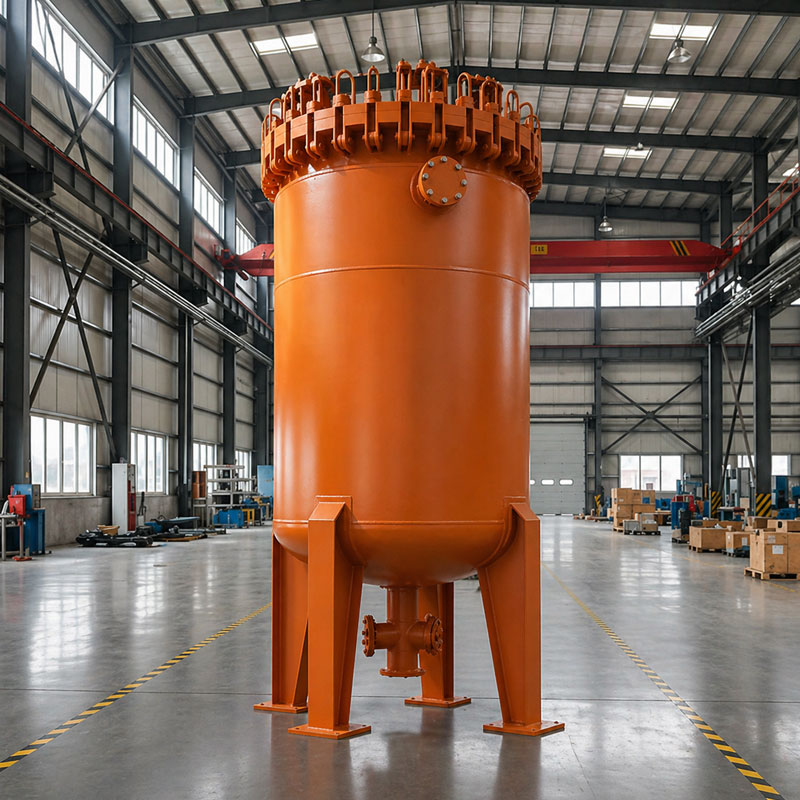
A pressure filter tank is a closed-loop system device, usually made of steel, with a vertical cylindrical shape (for small capacities) and a horizontal cylindrical shape (for large capacities). It is where the incoming water is stored before wastewater treatment.

Characteristics of Pressure Filter Tanks:
- Capable of handling very small solid particles.
- Fast water treatment time, providing timely supply for production processes.
- Small installation footprint.
- Can be installed indoors or outdoors.
- Simple operation. Automatic or manual control modes.
- Low maintenance costs.
- Suitable for wastewater treatment systems with high load capacity.
Pressure filter tanks are considered the first and most crucial step in a standard industrial wastewater treatment process. Typically, reactive agents are added during the filtration process in pressure filter tanks. This helps oxidize heavy metals and reduces pressure in subsequent filtration stages.
Pressure filter equipment is relatively simple to construct, primarily operating under pressure. Therefore, when water is pumped from the system into the tank, it is pumped through the next filtration process without the need for a secondary pumping system.

Advantages of Pressure Filter Tanks
Currently, the application of wastewater treatment using filter tanks plays a crucial role. Its presence and operational efficiency directly affect the results of industrial and domestic wastewater treatment.
Wastewater treatment using filter tanks is highly valued for its outstanding advantages:
- Quick installation, requiring minimal equipment space.
- Relatively low investment and operating costs, saving money in wastewater treatment.
- No need for a pump; it can easily and simply push water into the tank.
- No vacuum occurs in the filter layer, preventing sand from being carried out with the water flow.
- Easily increase filtration speed by increasing the thickness of the filter material layer.
For more details, please contact:
